


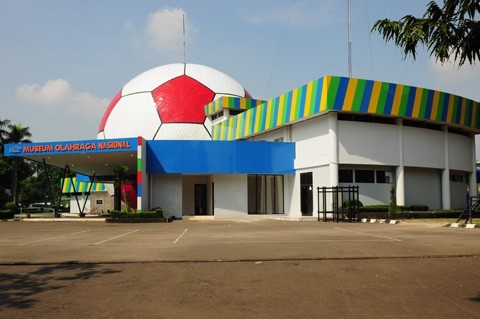
The National Sports Museum is a specialized cultural institution dedicated to preserving and presenting the history, achievements, and values of sports in Indonesia. Owned and managed by the Ministry of Youth and Sports, this museum plays a strategic role in documenting the nation’s sporting journey while inspiring future generations to embrace healthy and active lifestyles.
Classified as a Type B museum, the National Sports Museum is designed not only as a place of historical preservation but also as an educational and recreational space that reflects the spirit of sportsmanship, dedication, and national pride.
The History of the National Sports Museum
The idea of establishing the National Sports Museum was first initiated by Sri Sultan Hamengkubuwono IX, a prominent national figure known for his deep commitment to the development of sports in Indonesia. This visionary concept was later revived by Abdul Gofur in 1986, who also proposed Taman Mini Indonesia Indah (TMII) as the official location for the museum.
The architectural design of the museum was developed by Ir. Zaini Rachiman, while the layout, themes, and content were prepared by a professional team led by I Nyoman Nuarte. The official blueprint of the National Sports Museum was signed by Mrs. Tien Soeharto on July 1, 1987, marking an important milestone in the realization of the project.
Construction formally began with the laying of the first stone on October 4, 1987, conducted by Alamsyah Ratu Perwira Negara. After completion, the National Sports Museum was officially inaugurated by President Soeharto on April 20, 1989, coinciding with the 14th anniversary of Taman Mini Indonesia Indah. This inauguration symbolized the government’s commitment to honoring sports as an integral part of national history and identity.
Museum Type and Management
The National Sports Museum falls under the category of a specialized museum, as its focus is exclusively on sports and athletic achievements. It is fully owned and managed by the Ministry of Youth and Sports of the Republic of Indonesia, ensuring that its mission aligns with national policies related to youth development, education, and sports advancement.
As a Type B museum, it serves as a medium-scale institution with an emphasis on education, historical research, and public engagement through sports-related narratives.
National Sports Museum Collection
Currently, the National Sports Museum is recorded as having zero registered collections. Despite this, the museum’s value lies in its conceptual mission as a center for sports history studies and as a foundation for future collection development. The museum is envisioned as a dynamic space that can grow alongside Indonesia’s ongoing sports achievements at national and international levels.
Rather than focusing solely on physical artifacts, the museum emphasizes storytelling, historical documentation, and the symbolic meaning of sports accomplishments.
Vision of the National Sports Museum
The vision of the National Sports Museum is:
To preserve peak works and sports achievements as part of the study of sports history and its environment, while providing facilities that support the creation of a society that loves learning and lives a physically, mentally, and spiritually healthy life.
This vision highlights the museum’s broader role in promoting holistic well-being and lifelong learning through sports history.
Mission and Strategic Role
To achieve its vision, the National Sports Museum carries out several key missions:
- Providing facilities that encourage the public to develop a passion for learning and maintaining a healthy physical, mental, and spiritual lifestyle.
- Informing the public—especially youth and students—about the struggles and dedication of Indonesian athletes and national sports figures in bringing honor to the country on the international stage while upholding sportsmanship.
- Nurturing and motivating younger generations to achieve excellence in sports at both national and international levels.
- Optimizing the role of the museum as an educational and recreational tourism destination that is communicative, productive, innovative, and comfortable for the general public.
The National Sports Museum stands as an important symbol of Indonesia’s commitment to preserving sports heritage and celebrating athletic achievement. More than just a museum, it represents a space for reflection, inspiration, and education—connecting past sporting glory with future aspirations.
With continuous development and innovative programming, the National Sports Museum has the potential to become a meaningful destination for learning and recreation, while strengthening the national identity through the values of sports, perseverance, and fair play.