





[ALT IMG: Historical Sites in Indonesia - Indonesia Travel]
Our country is rich in various historical sites in Indonesia that preserve the traces of a grand civilization across generations. Exploring these destinations filled with cultural value will provide a meaningful and unforgettable holiday experience.
11 Historical Sites in Indonesia
Our country is well-known for being rich in heritage sites from the past that stretch from Sabang to Merauke. The following is a list of important historical heritage destinations that you must visit:
1. Candi Borobudur, Central Java
Candi Borobudur was built in the 8th century AD during the Syailendra Dynasty as the largest Buddhist religious center in the world.
Its uniqueness lies in the architecture of the giant stepped stupas decorated with thousands of relief panels depicting grand stories. Candi Borobudur was formerly used as a sacred place of worship, and today it remains standing firm and well-maintained as an international religious tourism center.
- Address: Jalan Badrawati, Kwangsan, Borobudur, Borobudur District, Magelang Regency, Central Java.
- Operating Hours: Open daily from 08:30 to 15:30 WIB.
- Admission Price: Starting from IDR 50,000 per person.
2. Benteng Rotterdam, South Sulawesi
Benteng Rotterdam or Fort Rotterdam was first built in 1545 by the 9th King of Gowa and was captured by the Dutch in the 17th century.
The uniqueness of this fort is its architectural shape resembling a sea turtle facing the sea as a symbol of maritime defense. This fort formerly functioned as a colonial defense and administrative center, and now serves as a cultural and historical museum complex.
- Address: Jalan Ujung Pandang, Bulo Gading, Ujung Pandang District, Makassar City, South Sulawesi.
- Operating Hours: Open daily from 08:00 to 18:00 WITA.
- Admission Price: Free.
3. Museum Mulawarman, East Kalimantan
Museum Mulawarman stands on the complex of the former palace of the Kutai Kartanegara Sultanate, which was established in 1936.
Its uniqueness lies in housing valuable collections of royal heritage such as the king's throne, ancient statues, and antique ceramic collections. This place was formerly used as the administrative center of the sultanate, and now functions as a center for preserving Kalimantan's history.
- Address: Jalan Tepian Pandan, Panji, Tenggarong District, Kutai Kartanegara Regency, East Kalimantan.
- Operating Hours: Open daily from 08:00 to 16:00 WITA.
- Admission Price: Starting from IDR 5,000 per person.
4. Istana Maimun, North Sumatra
Istana Maimun was built in 1888 by Sultan Makmun Al Rashid Perkasa Alamsyah of the Deli Sultanate.
Its uniqueness lies in combining unique architectural styles with Malay, Islamic, Spanish, Indian, and Italian elements in one grand building. This palace formerly served as the official residence of the Sultan of Deli, and is now open as a historical tourism object.
- Address: Jalan Brigjend Katamso, Sukaraja, Maimun District, Medan City, North Sumatra.
- Operating Hours: Open daily from 08:00 to 17:00 WIB.
- Admission Price: Starting from IDR 10,000 per person.
5. Masjid Menara Kudus, Central Java
Masjid Menara Kudus was established in 1549 AD by Sunan Kudus, combining Islamic and Hindu-Buddhist elements. In addition to being a mosque, this mosque complex also features a pilgrimage site, namely the Tomb of Sunan Kudus.
Its uniqueness lies in the old mosque tower made of ancient red brick, which resembles a temple building with Nusantara characteristics. This mosque was formerly the center of Islamic propagation in Java, and is currently actively used as a place of worship as well as a cultural heritage site.
- Address: Jalan Kauman, Kerjasan, Pekauman, Kota Kudus District, Kudus Regency, Central Java.
- Operating Hours: Open daily 24 hours for the public.
- Admission Price: Free.
Read Also: What to Do in Palembang: A 2-Day Travel Guide
6. Tirta Gangga, Bali
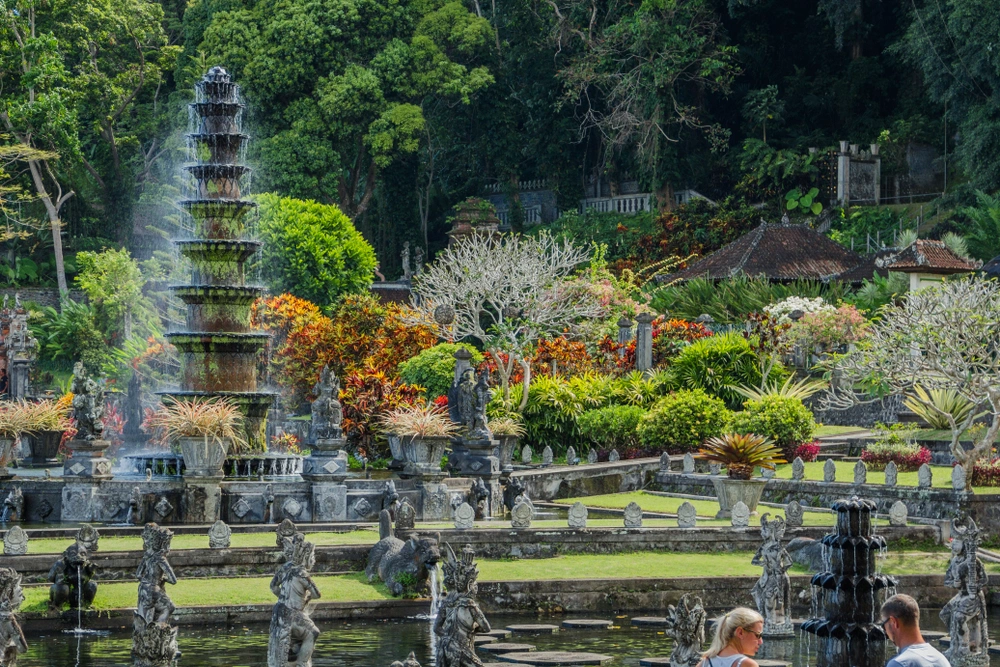
Tirta Gangga was built in 1948 by the King of Karangasem, Anak Agung Anglurah Ketut Karangasem. Its uniqueness lies in presenting a royal water garden complex filled with clear fish ponds, fountains, and aesthetic stone statues. This place formerly functioned as the king's private bathing place, and is now a favorite tourist destination for both domestic and foreign tourists.
- Address: Ababi Village, Abang District, Karangasem Regency, Bali.
- Operating Hours: Open daily from 08:00 to 17:00 WITA.
- Admission Price: Starting from IDR 40,000 per person.
7. Masjid Raya Baiturrahman, Aceh
Masjid Raya Baiturrahman was first built in 1612 by Sultan Iskandar Muda and was subsequently rebuilt by the Dutch colonials.
Its uniqueness is that the mosque features magnificent black domes with signature Mughal colonial architecture, surrounded by a spacious courtyard with giant umbrellas. This mosque was formerly the center of Islamic civilization in the Veranda of Mecca (Serambi Mekkah), and today stands firm as a symbol of the religious resilience of the Acehnese people.
- Address: Jalan Moh. Jam, Kampung Baru, Baiturrahman District, Banda Aceh City, Aceh.
- Operating Hours: Open daily 24 hours.
- Admission Price: Free.
8. Kota Tua, Jakarta
The Kota Tua Area began development as the center of Batavia by the VOC in the early 17th century. Its uniqueness lies in presenting rows of European colonial-era architecture surrounding the Fatahillah Square area.
This area was formerly the administrative center of the Dutch East Indies colonial government, and now serves as a popular urban historical tourism hub.
- Address: Jalan Taman Fatahillah, Pinangsia, Tamansari District, West Jakarta City, DKI Jakarta.
- Operating Hours: Open daily from 08:00 to 20:00 WIB.
- Admission Price: Free.
9. Jembatan Merah Surabaya, East Java
Jembatan Merah was built around the 1800s by order of Herman Willem Daendels as a strategic defense route.
Its uniqueness lies in holding the heroic historical records of the battle of "arek-arek Suroboyo" (Surabaya youth) against allied forces during the independence era. This bridge was formerly the trade artery of colonial commerce, and now functions as a connecting highway of the historic city.
- Address: Jalan Kembang Jepun, Pabean Cantian, Surabaya City, East Java.
- Operating Hours: Open daily 24 hours for the public.
- Admission Price: Free.
10. Benteng Concordia, NTT
Benteng Concordia was built during the Portuguese and Dutch colonial era around 1613 in the coastal area of Timor.
Its uniqueness lies in the remains of the sturdy stone wall ruins facing directly onto the panoramic waters of Kupang Bay. This fort formerly functioned as a military protective fortress, and is now a local ancient historical site.
- Address: Kawasan Pesisir Lama, Kupang City, East Nusa Tenggara.
- Operating Hours: Open daily from 08:00 to 17:00 WITA.
- Admission Price: Free.
11. Kedaton Kesultanan Ternate, North Maluku
Kedaton Kesultanan Ternate was built in 1813 on a coral hill by Sultan Muhammad Ali.
Its uniqueness is that it stands grandly in a shape resembling a human body, directly facing the open sea. This place was formerly the center of the throne of the archipelago's spice sultanate, and now functions as a museum storing the sultanate's heirlooms.
- Address: Soa Sio Sub-district, North Ternate District, Ternate City, North Maluku.
- Operating Hours: Open daily from 08:00 to 16:00 WIT.
- Admission Price: Starting from IDR 10,000 per person.
Read Also: Gili Trawangan: Tourism, Snorkeling & How to Get There
Keep This in Mind When Visiting Historical Sites
Good etiquette and visiting procedures will help preserve the cultural heritage sites of the nation's ancestors. The following are six important guidelines you can apply when exploring historical destinations in Indonesia:
- Wear polite and respectful clothing to respect the customary norms and sacredness of the historical sites visited.
- Always obey prohibitive signs such as not touching ancient artifacts and a prohibition on damaging archaeological structures.
- Keep the environment clean by not littering in the historical building complex area.
- Use official tour guide services if available so that you obtain accurate and in-depth historical insights.
- Prepare yourself physically and wear comfortable footwear, as site areas are usually quite extensive to explore.
- Respect local wisdom and the rules and regulations set by the management of the local cultural heritage site.
Read Also: Taman Imbi Jayapura, a City Icon with a Historical Nuance
Come on, Plan Your Trip now by arranging a special itinerary, so your exploration of various historical sites in Indonesia can be well-planned.
You can also ask for various recommendations and information from MaiA, an advanced virtual assistant ready to accompany your trip and provide the right recommendations for you.
References:
https://bimasbuddha.kemenag.go.id/borobudur/360/tentang-borobudur.html
https://disbudpar.sulselprov.go.id/page/budaya/181/benteng-fort-rotterdam
https://www.museummulawarman.org/tentang
https://itjen.kemendikdasmen.go.id/web/?p=9413
https://tourism.kuduskab.go.id/id/masjid-menara-kudus/
https://budayaaceh.com/cagar-budaya/329/masjid-raya-baiturrahman
https://www.wisatakotatua.com/sejarah-kota-tua/
https://dispar.malukuprov.go.id/destinasi/benteng-concordia
https://wonderful.ternatekota.go.id/destinasi/kedaton-kesultanan-ternate
Photo Credit:
Shutterstock/ArtNat