



Loading...

Story of Indonesia, Every Picture Tells A Story


Translate into:   powered by Google Translate
17 June 2011
Borobudur: The colossal Monument of Buddha

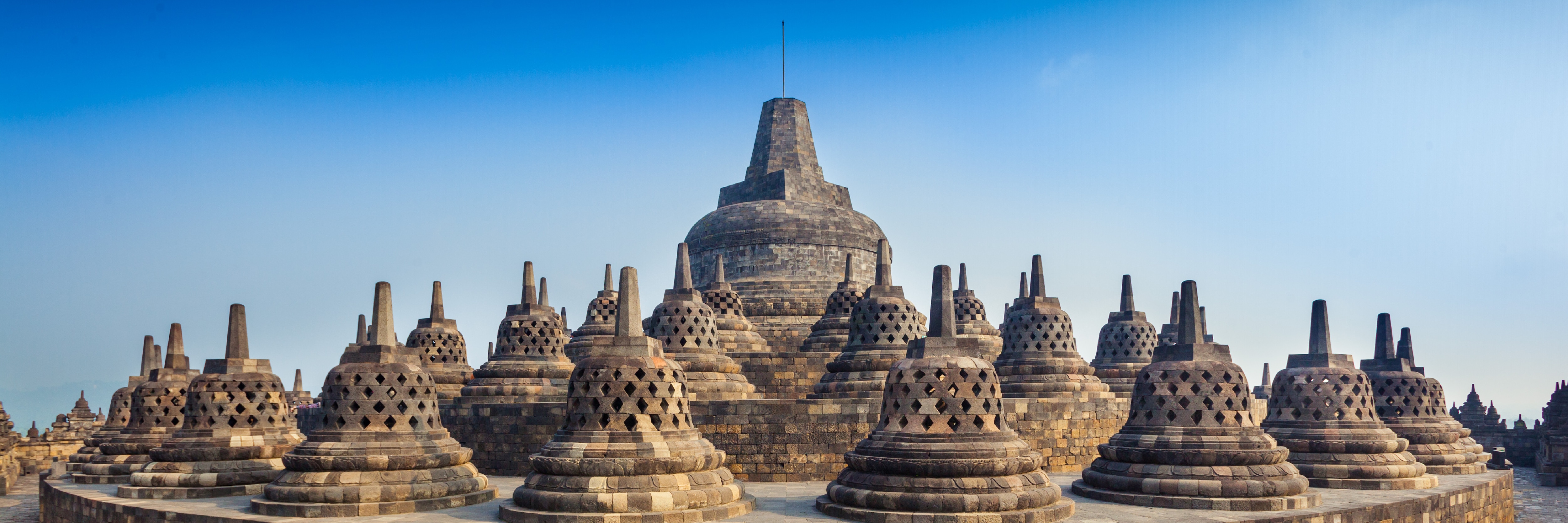
The magnificent Borobudur temple is the world’s biggest Buddhist monument, an ancient site widely considered to be one of the world’s seven wonders. Built in the 9th century during the reign of the Syailendra dynasty, the temple’s design in Gupta architecture reflects India's influence on the region, yet there are enough indigenous scenes and elements incorporated to make Borobudur uniquely Indonesian.

The temple sits majestically on a hilltop overlooking lush green fields and distant hills. The monument is a marvel of design, decorated with 2,672 relief panels and 504 Buddha statues. The architecture and stonework of this temple has no equal.  Built without using any kind of cement or mortar, the structure is like a set of massive interlocking Lego blocks held together without any glue.

This monument is both a shrine to the Lord Buddha and a holy place for Buddhist pilgrimage. The ten levels of the temple symbolize the three divisions of the religion’s cosmic system.

In the 1970’s the Indonesian Government and UNESCO worked together to restore Borobudur to its former majesty. The restoration took eight years to complete and today Borobudur is one of Indonesia and the world’s most valuable treasures.

All photos from indonesia.travel. Except no.16-26 taken by Sunaryo Kusumo.

1

Surrounded by volcanoes and shrouded in mystery, Borobudur Temple stands majestically at the heart of Central java as a mountain of a thousand statues.

2

The monument is a marvel of design, decorated with 2,672 relief panels and 504 Buddha statues.

3

As one ascends to the many levels of the temple, he can observe the stages of human life according to the teaching of Buddha.

4

The Buddha statues are perfectly placed in niches at the Rupadhatu level, arranged in rows on the outer sides of the balustrades.

5

As visitors circle each level of the temple, they are greeted with the amazing bas reliefs that decorate the walls of Borobudur.

6

Some of the reliefs in Borobudur illustrate the natural life and take on animal shapes. 

7

Consisting of 1,460 narrative and 1,212 decorative panels which cover the façades and balustrades, Borobudur holds approximately 2,670 individual bas reliefs.

8

On the last three circular uppermost terraces, 72 Stupas circle the huge main Stupa that crowns the top of the temple. 

9

The circular form of the Stupa represents Eternity with no beginning and without end, a superlative, tranquil, and pure state of the formless world.

10

The reliefs of the Rupadhatu level depict the stories based on the manuscripts of Lalitavistara, Jataka-Avadana and Gandavyuha.

11

Sitting silently overlooking the hills of Magelang, the magnificent Borobudur Temple is dedicated to the wise and benevolent teaching of the great Siddharta Gautama.  

12

The fine works of arts of the Javanese Syailendra era are sculpted in the many fascinating statues of Borobudur Temple.

13

The name Borobudur is believed to have been derived from the Sanskrit words vihara Buddha uhr, meaning the Buddhist monastery on the hill.

14

For centuries, Borobodur lay hidden under layers of volcanic ash. The reasons behind the desertion of this magnificent monument still remain a mystery.

15

Some scholars believe that famine caused by an eruption of Mount Merapi forced the inhabitants of Central Java to leave their lands behind in search of a new place to live, thus the glory of Borobudur was buried by the ash of the volcano.

16

Borobudur takes the form of a giant mandala, symbolically depicting the path of the bodhisattva from samsara to nirvana

17

A statue of a mythical creature stands at the ready to guard one of the best human achievements of the planet.

18

The locals believe that if one is able to touch the Buddha statue inside a Stupa, that person is blessed and will receive good fortune.

19

For many years, the sheer magnificence of the Borobudur Temple has attracted visitors from all over the globe.

20

A group of curious visitors enthusiastically observe the inner side of a Stupa.

21

Some scholars think that this massive monument is a gigantic textbook of Buddhism to help people achieve enlightenment.

22

A Buddha statue sits majestically inside a half-cut Stupa with the hand position of dharmachakra mudra or turning the Wheel of the Law.

23

Absorbing the sheer fascination of Borobudur Temple, an observant visitor sits stunned at the edge of the Stupa.

24

To read this Buddhist textbook in stone, one must walk more than two miles passing the impressive reliefs illustrating the life of Buddha Shakyamuni and the principles of his teachings.

25

UNESCO inducted Borobudur as a World Heritage Site in 1991, and listed it under Cultural criteria: "to represent a masterpiece of human creative genius".

26

For the restoration of  Borobudur post-Mount Merapi 2010 eruption, UNESCO  donated US$3 million as a part of rehabilitation costs.