


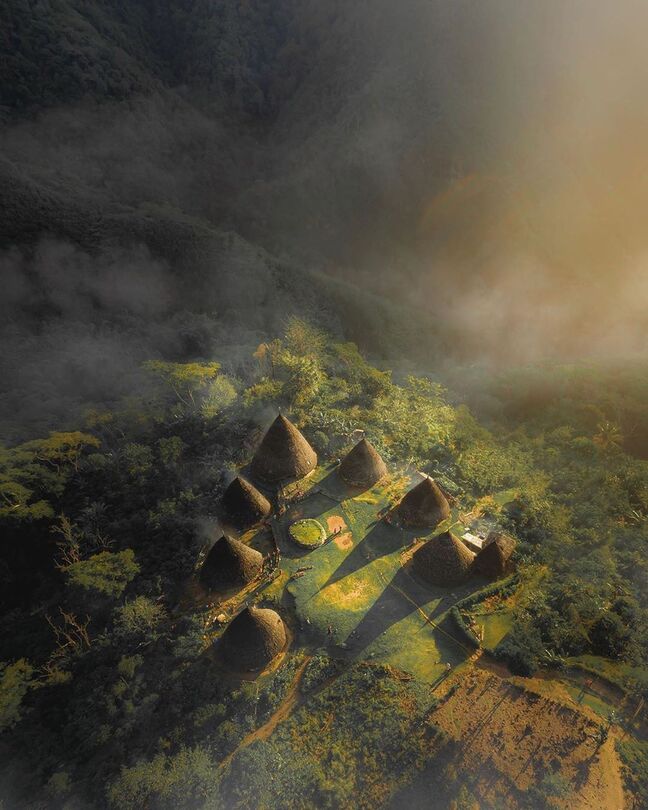




Sindangbarang, a village not too far from Bogor sought to restore its ancient tradition as the final procession of Seren Taun Guru Bumi took place on Monday, January 23rd , 2011. After a week full of sacred ceremonies, the procession came to a pinnacle with the harvest parade or the helaran dongdang followed by the rice mating or Majikeun Pare in the heart of the Sindangbarang Cultural Village. As a tradition that dated back to the age of Padjadjaran Kingdom, the Seren Taun Guru Bumi Ceremony was not merely a series of sacred rituals, but also a time of festivities. Villagers and crowds from everywhere could join in and mingle in this annual celebration. The celebration was also a time where nature and God are praised, cultures are honored, and wisdoms are passed down.
Farmer and his buffaloes plowed the paddy field, preparing fresh soil for new crops to grow as the tranquil village of Sindangbarang beautifully decorated the horizon (photo documentation by Andika Saputra/www.indonesia.travel).
The tiny feet and cute little faces of Sindangbarang (photo documentation by Andika Saputra/www.indonesia.travel).
A dongdang taking shape of a tiger made of oranges, pineapples, salak, and other freshly picked fruits were on its way to the gathering place before the parade (photo documentation by Andika Saputra/www.indonesia.travel).
Waiting for the parade to arrive, these young men bathed themselves in mud and covered their body with rice grains and took an ascetical forms on the rice field (photo documentation by Andika Saputra/www.indonesia.travel).
The chosen 4 young men made their way to the entrance of the village as the harvest parade approaching (photo documentation by Andika Saputra/www.indonesia.travel).
The helaran dongdang (harvest parade) arrived at the village, with the rice rengkong carriers as the leading group (photo documentation by Andika Saputra/www.indonesia.travel).
A million-dollar smile of the dongdang carriers as a heavy dongdang dance followed the rhythm of the angklung gubrag (photo documentation by Andika Saputra/www.indonesia.travel).
Led by “kendang” percussionists, the musical entourage entered the village as the morning slowly shifted to noon (photo documentation by Andika Saputra/www.indonesia.travel).
The Rengkong carriers reached its final destination as they arrived in the square of Sindangbarang Cultural Village (photo documentation by Andika Saputra/www.indonesia.travel).
The harvested rice were gathered before they made their final journey on the procession of majikeun pare (rice mating) inside the Ratna Inten rice barns (photo documentation by Andika Saputra/www.indonesia.travel).
Excitements rose as the Parebut Dongdang took place. Villagers and spectators, men and women, young and old, were all racing and competing to get anything they could get their hands on the dongdangs (photo documentation by Andika Saputra/www.indonesia.travel).
A happy face of a triumphant boy as he carried his trophy over the “cultural mosh-pit” of the dongdang giveaway (photo documentation by Andika Saputra/www.indonesia.travel).
10. Teenage girls performed the delicate dance of Jaipong in front of enthusiastic spectators (photo documentation by Andika Saputra/www.indonesia.travel).
Housewives faced each other in a uniquely fierce musical combat of “Angklung Gubrag” (photo documentation by Andika Saputra/www.indonesia.travel).
The two masters involved in a one-on-one battle of Pencak Silat as their apprentices supported them with the rhythm of the angklung (photo documentation by Andi Muhaimin/www.indonesia.travel).
The Chinese Lion dance leaped over the central field as the great ceremony of Seren Taun Guru Bumi 2011 in Sindangbarang Cultural village came to a closure (photo documentation by Andi Muhaimin/www.indonesia.travel).