Destinations in Indonesia
Views:14183
Home » Pulau Pramuka: Breeding the Endangered Hawksbill Turtles » Saving the beautiful Hawksbill Sea Turtles on Pramuka Island
Saving the beautiful Hawksbill Sea Turtles on Pramuka Island
Fixed Dimensions
-
Pulau Pramuka
Pulau Pramuka (foto oleh Veriyanta Kusuma)
-
Pulau Pramuka
Pulau Pramuka (foto oleh Veriyanta Kusuma)
-
Pulau Pramuka
Pulau Pramuka (foto oleh Veriyanta Kusuma)
-
Pulau Pramuka
Pulau Pramuka (foto oleh Veriyanta Kusuma)
-
Pulau Pramuka/Pramuka Island
-
Pulau Pramuka/Pramuka Island
-
Pulau Pramuka/Pramuka Island1
-
Pulau Pramuka/Pramuka Island2
-
Pulau Pramuka/Pramuka Island4
Overview
While beautiful beaches and captivating sceneries are most associated with Jakarta’s Thousand Islands, this island chain also houses some of the most fascinating creatures of the ocean. On the beautiful tiny Pramuka Island, the critically endangered Hawksbill Sea Turtles have found sanctuary and welcome visitors who wish to participate in its conservation program.
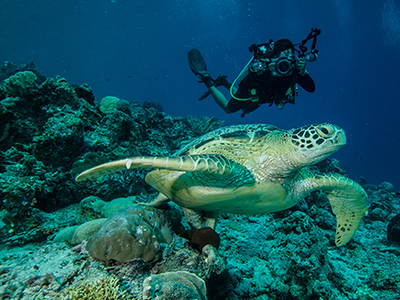
With the scientific name Eretmochelys imbricate, the Hawksbill Turtle belongs to the family of Cheloniidae and is recognized as the only extant species in its genus. On the whole, the hawksbill's appearance is similar to that of other marine turtles. It has a generally flattened body shape, a protective carapace, and flipper-like arms, adapted for swimming in the open ocean. But this unique turtle is easily distinguished from other sea turtles by its sharp, curving beak with prominent tomium, and the saw-like appearance of its shell margins. It is its sharp, curving beak which somehow resembles to that of a hawk that gave the turtle its popular name: The Hawksbill Turtle. Hawksbill shells change color slightly, depending on water temperature. While this turtle lives part of its life in the open ocean, it spends more time in shallow lagoons and coral reefs.
Adult hawksbill sea turtles are known to grow up to 1 meter (3 feet) in length, weighing around 80 kilograms (180 lb) on average. The heaviest hawksbill ever captured weighed 127 kilograms (280 lb). The turtle's shell, or carapace, has an amber background patterned with an irregular combination of light and dark streaks, with predominantly black and mottled brown colors radiating to the sides. The beautiful feature of the shell is the reason why people hunt these turtles and cause its worldwide endangerment.
The Hawksbill Turtle also plays an important part in the marine ecosystem. While they are omnivorous, sea sponges are the principal food of this fascinating creature. It is estimated that the Hawksbill Turtle consumes up to 1000 pounds or 450 Kg Sea sponges per year. This is a significant number that can control the growth of sea sponges and other coral organisms that may disturb the growth of the coral reefs itself.
The Hawksbill Turtle lives mainly in cool waters and is known to be able to roam the vast oceans for many miles. In the Indian Ocean, hawksbills are a common sight along the east coast of Africa, including the seas surrounding Madagascar and nearby island groups, all the way along the southern Asian coast, including the Persian Gulf, the Red Sea, and the coasts of the Indian subcontinent and Southeast Asia. They are present across the Indonesian archipelago and northern Australia. The Pacific range of E. imbricata is limited to the ocean's tropical and subtropical regions. In the west Pacific, it extends from the southwestern tip of the Korean Peninsula and the Japanese Archipelago down to northern New Zealand.
The conservation of Hawksbill Turtle in Pramuka Island began since 1984. It was initiated by a local personality named Mr. Salim with the sole purpose to prevent the hawksbill turtle from extinction. For over 30 years, Mr. Salim established a breeding center for the hawksbill turtle, which protects infant turtles before they are ready to be released into the open ocean.
The Conservation program includes several activities such as preserving the egg laying environment, rescuing turtles eggs from predators (including humans), hatching the eggs in semi-natural manner, taking care of infant turtles (tukik) before they are ready to be released, and increasing the awareness of the society towards the conservation of endangered species.
In this modest breeding center, thousands of turtle eggs have been rescued and hatched and subsequently released to the open ocean. It is recorded that in 1995 –with the aid of a Japanese Foundation- at least 10,000 turtles were released into the ocean. The average number of infant turtles released to the sea up to this moment reaches 3, 500 per year.
Related Destinations
- Old Batavia
- The Thousand Islands
- Jakarta: Dining Experience in Metropolitan City
- Jakarta Shopping Extravaganza
- Paradiso: The Name Says It All
- Sunda Kelapa Harbor
- Ancol
- Jakarta Street Food Scene
- Heritage Sites in Jakarta
- Senayan Golf Club
- Matoa National Golf
- The Schmutzer Primate Centre
- Taman Mini Indonesia Indah
- Waterbom Jakarta
- The National Museum
- The Fatahillah Jakarta Museum in Old Batavia
- The National Monument
- Jakarta
- Jakarta's Inspiring Istiqlal Mosque
- Jakarta Convention Center : Indonesia’s Largest Convention Venue
- Jakarta Exhibitions and Performance Venues
- Jakarta Hotels with Convention Facilities
- The Bung Karno Sports Complex: Jakarta’s Sports, Conventions and Entertainment Center
- Amazing Golf in the heart of Jakarta
- Bidadari Island: Dolphins and Romantic Tropical Sunsets
- PULAU TIDUNG, weekend get-away in Jakarta’s Thousand Islands
- Toko Merah
- GEDUNG PROKLAMASI
- Candra Naya building: a piece of Chinese history in colonial Batavia
- Batavia’s colonial National Archives Museum for elegant garden parties and weddings
- Monetary History in the Bank of Indonesia Museum
- The Bank Mandiri Museum to see Old-style banking
- Heritage Mosques in Old Batavia
- Jakarta’s Neo Gothic Catholic Cathedral
- Pari Island