Destinations in Indonesia
Views:58026
Home » Derawan Archipelago » Dive with Giant Manta Rays in the Tropical Waters of Derawan
Dive with Giant Manta Rays in the Tropical Waters of Derawan
Overview
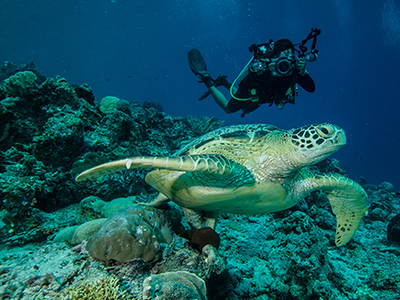
Although there is an abundance of beautiful tropical fish among the waters of the Derawan Archipelago, there is one species that is not as easily found. This is the giant Manta Ray. Indonesia is blessed with several locations where these particular giant creatures have made their home. One of the best locations to dive and swim along with these magnificent rays is at Pulau Sangalaki, in the Derawan region of East Kalimantan.
The word “manta” is taken from the Spanish word for "blanket". This may have been due to its seemingly flattened body with its pectoral fins that give it an appearance similar to that of a giant blanket spanning across the sea. In spite of its giant body, and it being a part of the shark family, the Manta ray does not attack humans. Out of the approximate 40 species of stingray in the world (Myliobatidae), the Manta are said to be the largest. The average width of the Manta rays at Pulau Sangalaki were found to be 3.5 meters, however, there have been some larger rays which measured up to 6 meters across. These giant sea creatures can reach a body weight of up to 3 tons!
The Manta Ray has two sets of fins – the pectoral fins and the cephalic fins. These fins are rolled up when it swims and then laid out flat when searching for food. The fins can span about 20 feet when they are spread out. There are also five slits for gills on both sides which function as a filter to let out water while the plankton and food remains. Manta rays eat plankton as their main food source as well as small shrimp and fish. Mantas have approximately 300 teeth which are almost completely hidden under the skin. These teeth are not used for eating, but reportedly, - though not yet proven, - these teeth may be involved in the Mantas’ mating rituals.
Manta rays have soft bones and are included in the group of animals that reproduce through ovoviviparity, meaning the embryos are retained in an egg which stays in the mother’s body until it is ready to hatch. A female manta can accommodate 2 baby rays at once. According to estimates, Manta rays have a gestation period of between 9 – 12 months and newborns are approximately 2 meters wide, and can weigh up to 45 kilos.
The tail is very long and skinny which many people agree seems out of place with the rest of its body shape. It can be seen whipping around very rapidly and there is a spine that runs down the tail.
The brain capacity of a Manta is reportedly quite a bit higher than other stingrays and sharks making this particular species more intelligent than its other marine counterparts.
Manta rays have a protective layer of mucus on their skin which needs to be cleaned regularly. They do this with the help of smaller fish which eat the bacteria and parasites off their bodies. If you are lucky enough to be in the right place at the right time you will be able to witness this impressive feat of nature, where the giant manta is surrounded by a large group of small fish such as the Ramora fish. Groups of up to 20 Manta rays have been seen in the waters around Pulau Sangalaki surrounded by schools of hundreds tiny fish. Swimming alongside a group of such amazing giant marine creatures will, without a doubt, be an impressive experience not soon forgotten.
Manta rays have been put in the category of Near Endangered Species by the International Union for Conservation of Nature (IUNC). This is due to the fact that the Manta population has been rapidly declining and is expected to continue to decline which will eventually lead to its extinction. Many factors are affecting this, such as sea pollution, the low Manta birth rate, and Manta poaching.
The Manta rays have become a big target for local fishermen who catch them for their meat. Just a manta tail can fetch up to Rp 3 million. Even the manta gills have become a highly sought after commodity as it is believed to enhance the male prowess. The meat of the Manta rays are usually sold and processed or dried and made into jerky.
Aside from the Derawan cluster of islands in East Kalimantan, you can also enjoy the Manta ray experience at several other locations throughout Indonesia such as at Raja Ampat in West Papua, Nusa Penida in Bali, and Karang Makassar in the Komodo National Park.
Related Event
-
15 Sep 2013-30 Sep 2013
Derawan Festival 2013: Derawan for the Future
Related Destinations
- Teritip Crocodile Breeding Center
- Kutai National Park
- Melawai Beach
- Mahakam River
- Kumala Island Tourism Park
- Wanawisata Forest
- Manggar Segara Sari Beach
- Kutai Sultan Palace (Mulawarman Museum)
- Sangalaki, Underwater Paradise
- Pampang Cultural Park
- Padang Golf Sepinggan
- Karang Joang Balikapapan Resort Golf & Country Club
- Kayan Mentarang National Park